
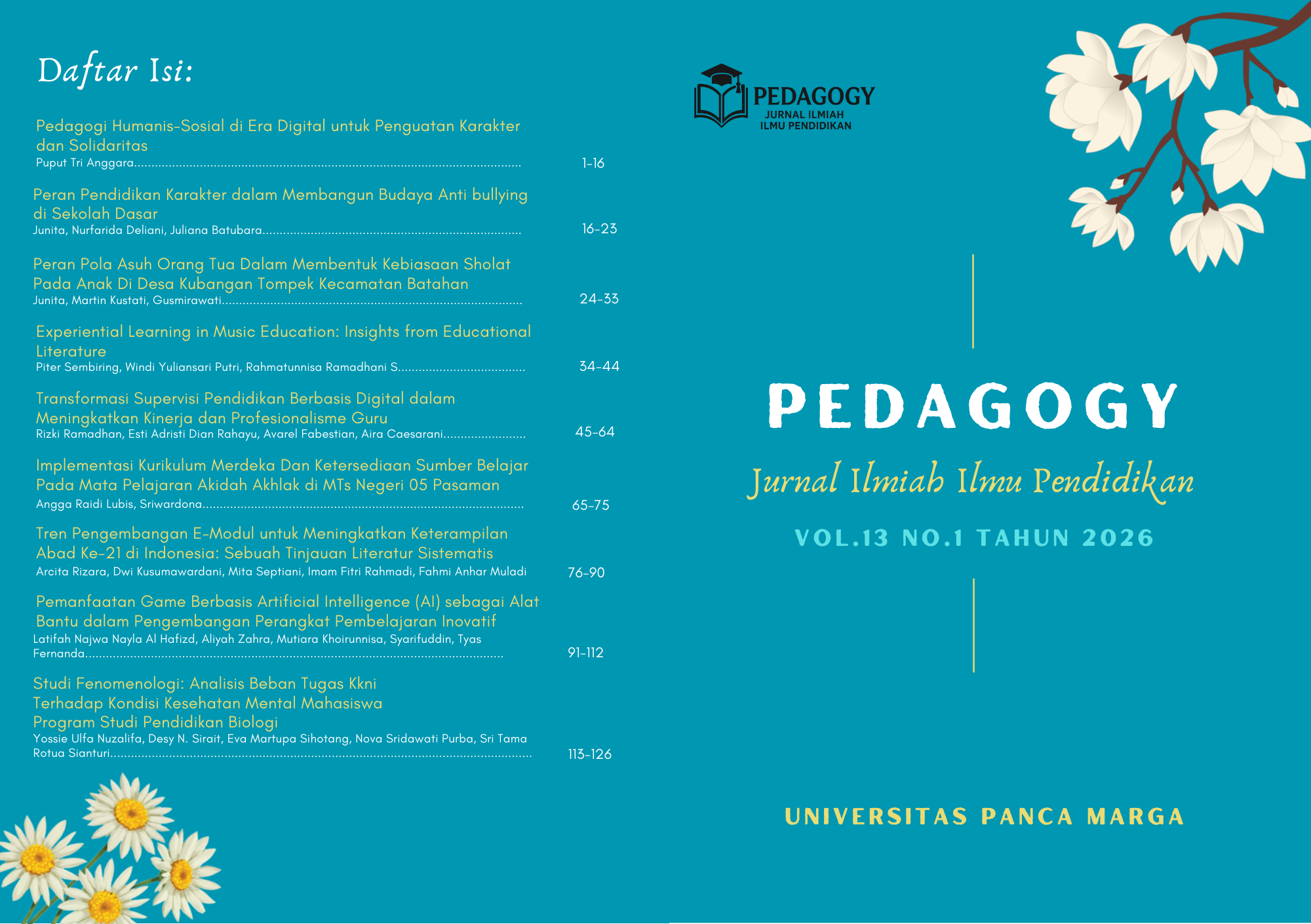
Experiential Learning in Music Education: Insights from Educational Literature
Keywords:
experiential learning, musical experience, music education, reflective learningAbstract
Music learning is fundamentally shaped by direct experience, yet conceptual discussions of experiential learning within music education remain dispersed across existing scholarship. This study aims to examine how experiential learning is articulated and interpreted in music education literature. A qualitative literature-based approach was employed by reviewing twelve selected scholarly articles addressing experiential learning across diverse music education contexts. Data were analysed using thematic synthesis to identify recurring conceptual patterns, forms of musical learning experiences, and connections between experience, reflection, and musical understanding. The findings indicate that experiential learning consistently positions musical experience as the core of learning, while reflective processes and social interaction support the development of sustained musical understanding. These results highlight experiential learning as a conceptual framework that frames music learning as a contextual and meaning-oriented process rather than the transmission of discrete knowledge
Downloads
References
Babazadeh, M., Botturi, L., & Reggiani, G. (2022). Let’s Jazz: a Case Study on Teaching Music with Educational Escape Rooms. European Conference on Games Based Learning, 16(1), 656–665. https://doi.org/10.34190/ecgbl.16.1.854
Bell, R., & Bell, H. (2020). Applying educational theory to develop a framework to support the delivery of experiential entrepreneurship education. Journal of Small Business and Enterprise Development, 27(6), 987–1004. https://doi.org/10.1108/JSBED-01-2020-0012
Benjamins, L., Roland, S. L., & Bylica, K. (2022). The complexities of meaningful experiential learning: Exploring reflective practice in music performance studies. International Journal of Music Education, 40(2), 163–176. https://doi.org/10.1177/02557614211043224
Bond, V. L., & Russell, J. A. (2021). Culturally Responsive Pedagogical/Andragogical Context Knowledge: A Conceptual Model for Music Education. Journal of Music Teacher Education, 30(3), 11–25. https://doi.org/10.1177/1057083721993738
Boucher, H., & Moisey, T. (2019). An Experiential Learning of a Philosophy of Music Education Inspired by the Work of Canadian Composer R. Murray Schafer. Creative Education, 10(10), 2111–2131. https://doi.org/10.4236/ce.2019.1010153
Bussu, A., & Mangiarulo, M. (2024). Playing music together: Exploring the impact of a classical music ensemble on adolescent’s life skills self-perception. PLOS ONE, 19(7), e0306326. https://doi.org/10.1371/journal.pone.0306326
Hadjikou, C. (2022). Students’ motivation to engage in music lessons: The Cypriot context. Research Studies in Music Education, 44(2), 413–431. https://doi.org/10.1177/1321103X20985302
Han, X., & Augustine, C. (2025). Research Status and Development Trends of Experiential Learning in Music Education: A Bibliometric Analysis. Journal of Curriculum and Teaching, 14(4), 138–162. https://doi.org/10.5430/jct.v14n4p138
Heinrich, W. F., & Green, P. M. (2020). Remixing Approaches to Experiential Learning, Design, and Assessment. Journal of Experiential Education, 43(2), 205–223. https://doi.org/10.1177/1053825920915608
Holochwost, S. J., Bose, J. H., Stuk, E., Brown, E. D., Anderson, K. E., & Wolf, D. P. (2021). Planting the Seeds: Orchestral Music Education as a Context for Fostering Growth Mindsets. Frontiers in Psychology, 11. https://doi.org/10.3389/fpsyg.2020.586749
Howe, J. H., & Baumgartner, E. S. (2024). Enhancing tonal-language learning through music: A review of experimental methods and melodic intonation therapy influences. Review of Education, 12(2), 1–16. https://doi.org/10.1002/rev3.3480
Huyler, D., & McGill, C. M. (2019). Research Design: Qualitative, Quantitative, and Mixed Methods Approaches, by John Creswell and J. David Creswell. Thousand Oaks, CA: Sage Publication, Inc. 275 pages, $67.00 (Paperback). New Horizons in Adult Education and Human Resource Development, 31(3), 75–77. https://doi.org/10.1002/nha3.20258
Isabirye, J. (2021). Can indigenous music learning processes inform contemporary schooling? International Journal of Music Education, 39(2), 151–166. https://doi.org/10.1177/0255761421996373
Jacobs, R. F. (2022). Arts-based critical service-learning experiences as transformative pedagogy. Journal of Pedagogy, 13(2), 29–53. https://doi.org/10.2478/jped-2022-0007
Jiang, M. (2024). The Role of Experiential Learning in Transforming Music Appreciation Education and Pedagogical Practices. Pacific International Journal, 7(5), 157–162. https://doi.org/10.55014/pij.v7i5.715
Kolb, A. Y., & Kolb, D. A. (2022). Experiential Learning Theory as a Guide for Experiential Educators in Higher Education. Experiential Learning and Teaching in Higher Education, 1(1), 38. https://doi.org/10.46787/elthe.v1i1.3362
Kong, Y. (2021). The Role of Experiential Learning on Students’ Motivation and Classroom Engagement. Frontiers in Psychology, 12(October), 10–13. https://doi.org/10.3389/fpsyg.2021.771272
Liu, M.-N., Liou, Y.-J., Wang, W.-C., Su, K.-C., Yeh, H.-L., Lau, C., Hu, L.-Y., Tsai, S.-J., & Chen, H.-Y. (2021). Group Music Intervention Using Percussion Instruments to Reduce Anxiety Among Elderly Male Veterans with Alzheimer Disease. Medical Science Monitor, 27. https://doi.org/10.12659/MSM.928714
López‐Íñiguez, G., & McPherson, G. E. (2020). Applying Self-Regulated Learning and Self-Determination Theory to Optimize the Performance of a Concert Cellist. Frontiers in Psychology, 11. https://doi.org/10.3389/fpsyg.2020.00385
Maina, K. (2024). Experiential Knowledge as a Musical Resource. PAN African Journal of Musical Arts Education, 2(1), 1–11. https://doi.org/10.58721/pajmae.v2i1.519
Marougkas, A., Troussas, C., Krouska, A., & Sgouropoulou, C. (2023). Virtual Reality in Education: A Review of Learning Theories, Approaches and Methodologies for the Last Decade. Electronics, 12(13), 2832. https://doi.org/10.3390/electronics12132832
Massy, P. J., & Sembiante, S. F. (2023). Pedagogical practices, curriculum development, and student experiences within postsecondary music education: A systematic literature review. Research Studies in Music Education, 45(3), 600–615. https://doi.org/10.1177/1321103X221128172
Nugraha, J. (2022). Penerapan Model Experiential Learning Terhadap Peningkatan Keterampilan Bermain Musik Ansamble Peserta Didik Pada Mata. SICEDU : Science and Educational Journal, 1(2), 81–87.
Nugraha, J., -, S., & -, M. (2021). Pengembangan Modul Seni Musik Berbasis Experiential Learning untuk Meningkatkan Kemampuan Bermain Musik pada Mata Pelajaran Seni Budaya dan Prakarya Siswa Sekolah Dasar. El-Ibtidaiy:Journal of Primary Education, 4(2), 189. https://doi.org/10.24014/ejpe.v4i2.13830
Osborne, M. S., McPherson, G. E., Miksza, P., & Evans, P. (2021). Using a microanalysis intervention to examine shifts in musicians’ self-regulated learning. Psychology of Music, 49(4), 972–988. https://doi.org/10.1177/0305735620915265
Page, M. J., McKenzie, J. E., Bossuyt, P. M., Boutron, I., Hoffmann, T. C., Mulrow, C. D., Shamseer, L., Tetzlaff, J. M., Akl, E. A., Brennan, S. E., Chou, R., Glanville, J., Grimshaw, J. M., Hróbjartsson, A., Lalu, M. M., Li, T., Loder, E. W., Mayo-Wilson, E., McDonald, S., … Moher, D. (2021). The PRISMA 2020 statement: an updated guideline for reporting systematic reviews. BMJ, n71. https://doi.org/10.1136/bmj.n71
Sætre, J. H., & Zhukov, K. (2021). Let’s play together: teacher perspectives on collaborative chamber music instruction. Music Education Research, 23(5), 553–567. https://doi.org/10.1080/14613808.2021.1979499
Salleh, M., & Mohamed Razali, C. S. M. (2020). Creative music making through composition workshop for higher education educators: An experiential learning. Journal Of Research, Policy & Practice of Teachers & Teacher Education, 10(2), 32–48. https://doi.org/10.37134/jrpptte.vol10.2.3.2020
Sandberg, J., & Alvesson, M. (2021). Meanings of Theory: Clarifying Theory through Typification. Journal of Management Studies, 58(2), 487–516. https://doi.org/10.1111/joms.12587
Savage, J. (2021). Teaching music in England today. International Journal of Music Education, 39(4), 464–476. https://doi.org/10.1177/0255761420986213
Stoll, N. (2024). Seven Steps to Mixing Success: Applying Experiential Learning Theory to Teaching Music Mixing. Journal of the Music and Entertainment Industry Educators Association, 24(1), 37–51. https://doi.org/10.2478/meiea-2024-0004
Tembrevilla, G., Phillion, A., & Zeadin, M. (2024). Experiential learning in engineering education: A systematic literature review. Journal of Engineering Education, 113(1), 195–218. https://doi.org/10.1002/jee.20575
Vaizman, T., & Harpaz, G. (2023). Retuning music teaching: Online music tutorials preferences as predictors of amateur musicians’ music self-efficacy in informal music learning. Research Studies in Music Education, 45(2), 397–414. https://doi.org/10.1177/1321103X221100066
Vårheim, A., & Skare, R. (2022). Mapping the research on museums and the public sphere: a scoping review. Journal of Documentation, 78(3), 631–650. https://doi.org/10.1108/JD-04-2021-0085
Woody, R. H. (2021). Music education students’ intrinsic and extrinsic motivation: A quantsitative analysis of personal narratives. Psychology of Music, 49(5), 1321–1343. https://doi.org/10.1177/0305735620944224
Xiaoya, Q., Karanyathikul, A., & Kotchasit, S. (2025). Development of a Basic Music Course Using Dave’s Sequencing Combined with Experiential Learning to Enhance the Musical Ability of Students. International Journal of Sociologies and Anthropologies Science Reviews, 5(1), 249–260. https://doi.org/10.60027/ijsasr.2025.5349
Downloads
Published
Issue
Section
License
Copyright (c) 2026 Pedagogy : Jurnal Ilmiah Ilmu Pendidikan

This work is licensed under a Creative Commons Attribution-NonCommercial-ShareAlike 4.0 International License.