
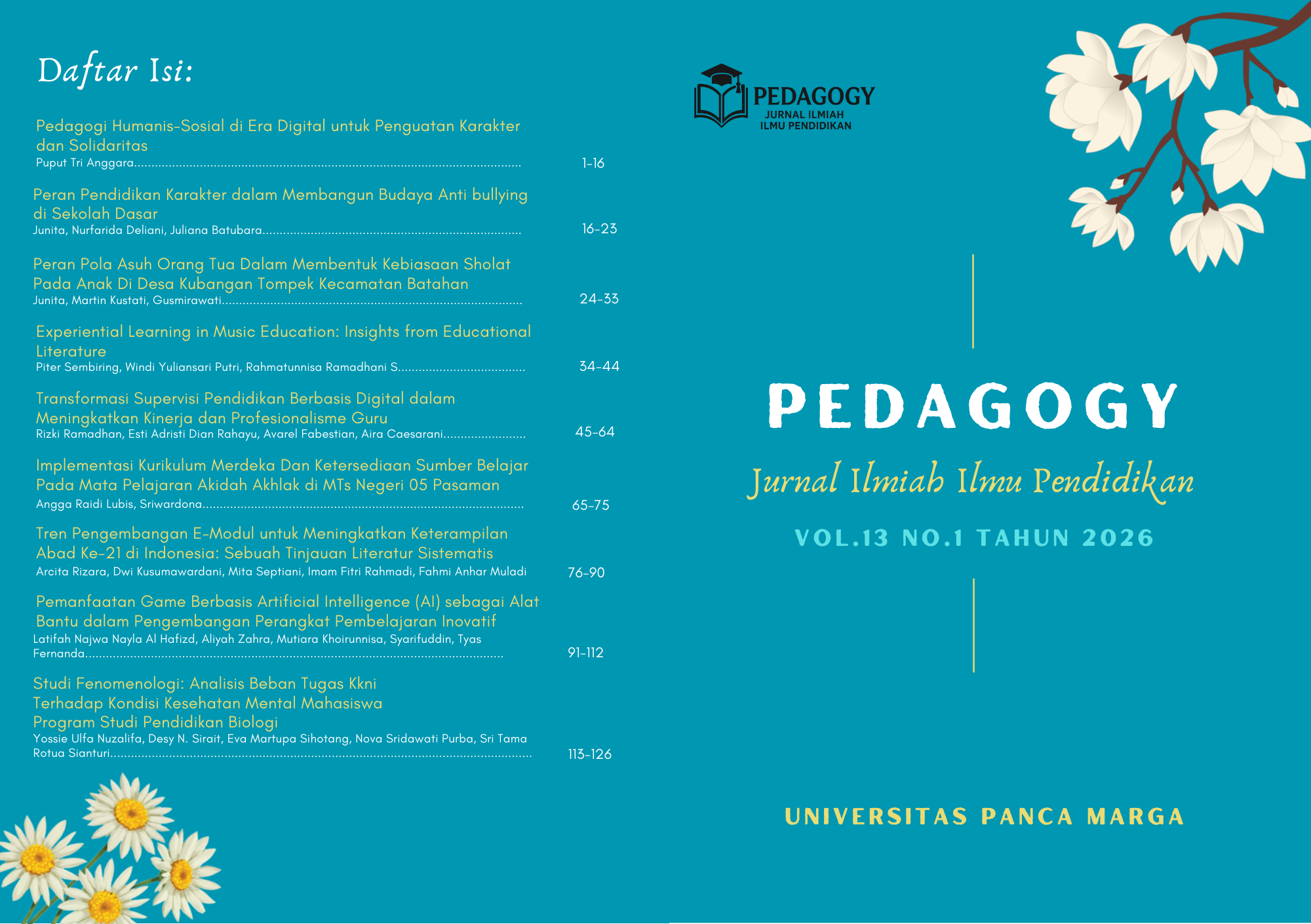
Pedagogi Humanis-Sosial di Era Digital untuk Penguatan Karakter dan Solidaritas
Abstract
Penelitian ini bertujuan menganalisis bagaiman pendidikan di era digital berfungsi sebagai ruang humanisasi melalui penguatan solidaritas, penerapan pedagogi humanis-sosial dan perannya sebagai agen transformasi. Metode yang digunakan adalah pendekatan kualitatif dengan analisis bibliometrik melalui peninjuan dan pemetaan literatur sistematis untuk mengidentifikasi tren, klaster tematik dan hubungan intelektual terkait pendidikan karakter, pedagogi sosial dan etika teknologi. Hasil menunjukkan pendidikan sebagai arena pembentukan nilai kemanusiaan, dialog sosial dan solidaritas untuk menghadapi meningkatnya individualisme, sementara pedagogi humanis-sosial mendukung ruang belajar yang inklusif dan sesuai dengan kebutuhan peserta didik. Penelitian ini menegaskan pentingnya kerangka berbasis nilai dalam integrasi teknologi agar praktik pendidikan tidak terjebak dehumanisasi serta perlunya kolaborasi sekolah, keluarga dan masyarakat dalam memperkuat karakter literasi digital peserta didik. Simpulan dan saran dimana pendidikan memiliki peran strategis memperkuat nilai kemanusiaan dan solidaritas. Penelitian selanjutnya memperdalam terkait pendidikan digital dan mengembangkan model pedagogi humanis-sosial.
Downloads
References
Akin-sabuncu, S., Eun, S., Chen, C., & Goodwin, A. L. (2024). Reimagining teacher education for immigrant students in the context of global migration : Teacher educators ’ perspectives. Teaching and Teacher Education, 143(March), 104550. https://doi.org/10.1016/j.tate.2024.104550
Anggita, S., Endraswara, S., & Rohman, A. (2024). Heliyon Revitalizing local wisdom within character education through ethnopedagogy apporach : A case study on a preschool in Yogyakarta. Heliyon, 10(10), e31370. https://doi.org/10.1016/j.heliyon.2024.e31370
Anton, A., Ravazzani, S., Baquerizo-neira, G., Andrea, C., & Mukiza, D. (2025). Bridging practice and academia : Global insights on the role and future of public relations education. Public Relations Review, 51(5), 102620. https://doi.org/10.1016/j.pubrev.2025.102620
Ayay-arista, G., Estrada-araoz, E. G., Huamani-mendoza, F. S., Alberto, E., Coronel-chugden, W., Julon-sanchez, M. M., & Aguilar-castillo, J. A. (2025). Social Sciences & Humanities Open Modeling pro-environmental competencies to mitigate sustainable development challenges in university students. 12(September). https://doi.org/10.1016/j.ssaho.2025.102055
Birhan, W., Shiferaw, G., Amsalu, A., & Tamiru, M. (2021). Exploring the context of teaching character education to children in preprimary and primary schools. Social Sciences & Humanities Open, 4(1), 100171. https://doi.org/10.1016/j.ssaho.2021.100171
Boyd, C., Parr, H., & Philo, C. (2023). Climate anxiety as posthuman knowledge Candice. Wellbeing, Space and Society, 4(December 2021), 100120. https://doi.org/10.1016/j.wss.2022.100120
Briones, E., Gallego, T., & Palomera, R. (2022). Creative Drama and Forum Theatre in initial teacher education : Fostering students ’ empathy and awareness of professional con fl icts. Teaching and Teacher Education, 117, 103809. https://doi.org/10.1016/j.tate.2022.103809
Bryan, A. (2022). Pedagogy of the implicated: advancing a social ecology of responsibility framework to promote deeper understanding of the climate crisis. Pedagogy Culture and Society, 30(3), 329–348. https://doi.org/10.1080/14681366.2021.1977979
Cemiloglu, D., Basel, M., Mcalaney, J., & Ali, R. (2022). Combatting digital addiction : Current approaches and future directions. Technology in Society, 68(December 2021), 101832. https://doi.org/10.1016/j.techsoc.2021.101832
Chaudhary, P., & Singh, R. K. (2024). Quality of teaching & learning in higher education: a bibliometric review & future research agenda. On the Horizon, 32(4). https://doi.org/10.1108/OTH-06-2023-0025
Chiappa, R., Carolina, G., & Guzm, C. (2025). Transforming regional higher education : the decolonising role of Indigenous-inspired universities in Latin America. 133(January). https://doi.org/10.1016/j.ijer.2025.102731
Crew, T. (2024). Exploring student support , class solidarity and transformative pedagogy : insights from Working Class Academics Exploring student support , class solidarity and Academics. British Journal of Sociology of Education, 45(7–8), 1042–1058. https://doi.org/10.1080/01425692.2024.2392146
Daruwala, I., Shramko, M., Clancy, E., Salinas, V., Edwards, I., Jiang, J. Y., & Kendziora, K. (2025). Social and Emotional Learning : Research , Practice , and Policy Using statewide policy to promote student and adult social-emotional competencies : Implementation evaluation of the Learning Renewal — Social Emotional Learning initiative. Social and Emotional Learning: Research, Practice, and Policy, 6(August 2024), 100165. https://doi.org/10.1016/j.sel.2025.100165
Frick, P., & Schüler, A. (2023). Extending the theoretical foundations of multimedia learning : Activation , integration , and validation occur when processing illustrated texts. Learning and Instruction, 87(June), 101800. https://doi.org/10.1016/j.learninstruc.2023.101800
Garfield, E. (1979). Citation indexing - its theory and application in science, technology, and humanities. Wiley. https://archive.org/details/citationindexing0000garf
Guo, Q. (2024). Prompting Change: ChatGPT’s Impact onDigital Humanities Pedagogy– A Case Study in Art History. Internasional Journal Humanities and Arts Computing, 1(2024), 58–78. https://doi.org/10.3366/ijhac.2024.0321
Hank, K., & Steinbach, A. (2018). Intergenerational solidarity and intragenerational relations between adult siblings. Social Science Research, 76, 55–64. https://doi.org/10.1016/j.ssresearch.2018.08.003
Hayashi, Y., Shimojo, S., & Kawamura, T. (2025). Scripted interventions versus reciprocal teaching in collaborative learning : A comparison of pedagogical and teachable agents using a cognitive architecture. Learning and Instruction, 96(April 2024), 102057. https://doi.org/10.1016/j.learninstruc.2024.102057
Iskandar, R., Maksum, A., & Marini, A. (2025). Social Sciences & Humanities Open Digital citizenship literacy in Indonesia : The role of privacy awareness and social campaigns. Social Sciences & Humanities Open, 12(June), 101697. https://doi.org/10.1016/j.ssaho.2025.101697
Jeder, D. (2013). Teachers ’ Ethic Responsibilities in the Practice of Education and Training. Procedia - Social and Behavioral Sciences, 92(Lumen), 432–436. https://doi.org/10.1016/j.sbspro.2013.08.697
Jr, D. B. E. (2024). Hidden in plain sight : The foundations and limitations of global governance and global goals. International Journal of Educational Development, 106(February), 103013. https://doi.org/10.1016/j.ijedudev.2024.103013
Kaakinen, M. (2024). Inclusive education by teachers to the development of the social and emotional competencies of their students in secondary education. 91(February). https://doi.org/10.1016/j.learninstruc.2024.101892
Keenan, H. B. (2022). Methodology as Pedagogy: Trans Lives, Social Science, and the Possibilities of Education Research. Educational Researcher, 51(5), 307–314. https://doi.org/10.3102/0013189X211065740
Lan, Y. (2024). Through tensions to identity-based motivations : Exploring teacher professional identity in Artificial Intelligence-enhanced teacher training. 151(November 2023). https://doi.org/10.1016/j.tate.2024.104736
Museus, S. D. (2021). “We Really Have to Come Together”: Understanding the Role of Solidarity in Asian American College Students’ Social Justice Activism and Advocacy. Education Sciences, 11(11). https://doi.org/10.3390/educsci11110683
Nane, G. F., Larivière, V., & Costas, R. (2017). Predicting the age of researchers using bibliometric data. Journal of Informetrics, 11(3). https://doi.org/10.1016/j.joi.2017.05.002
Neolaka, A., Iasha, V., & Setiawan, B. (2022). How is the Education Character Implemented ? The Case Study in Indonesian Elementary School. 371–380. https://doi.org/10.36941/jesr-2022-0029
Palm, M., Raynor, K., & Grajdura, S. (2025). Bridging access with life satisfaction and Nussbaum ’ s. Transportation Research Part D, 146(June), 104877. https://doi.org/10.1016/j.trd.2025.104877
Prem, E. (2024). Principles of digital humanism : A critical post-humanist view. Journal of Responsible Technology, 17(January), 100075. https://doi.org/10.1016/j.jrt.2024.100075
Richter, E., Carpenter, J. P., & Richter, D. (2024). Digital social support among educators in social media : An international comparative study of tweets and replies in # teachertwitter and # twlz ☆. 221(August). https://doi.org/10.1016/j.compedu.2024.105137
Romero-moreno, F. (2025). Deepfake detection in generative AI : A legal framework proposal to protect human rights. In Computer Law & Security Review: The International Journal of Technology Law and Practice (Vol. 58, Issue June). Elsevier Ltd. https://doi.org/10.1016/j.clsr.2025.106162
Rosa, B. (2024). In pursuit of social emotional learning in a Swedish pre-service teacher education programme : A qualitative study of intended curriculum. Teaching and Teacher Education, 142(February). https://doi.org/10.1016/j.tate.2024.104527
Salonen, A. O., & Sterling, S. (2023). A Theory of Planetary Social Pedagogy. 73(4), 615–637. https://doi.org/10.1111/edth.12588
Sanjakdar, F., & Premier, J. (2023). Teaching for social justice in higher education : Re fl exive and critical auto-ethnographic narratives of hope , resilience , and change. Teaching and Teacher Education, 127, 104114. https://doi.org/10.1016/j.tate.2023.104114
Sharma, U., Sokal, L., Wang, M., & Loreman, T. (2021). Measuring the use of inclusive practices among pre-service educators : A multi-national study. 107. https://doi.org/10.1016/j.tate.2021.103506
Sinnema, C., Liou, Y., Daly, A., Cann, R., & Rodway, J. (2021). When seekers reap rewards and providers pay a price : The role of relationships and discussion in improving practice in a community of learning. 107. https://doi.org/10.1016/j.tate.2021.103474
Slakmon, B. (2022). Effects of dialogic education on sensemaking : Changes in teachers ’ narrative structure. 115. https://doi.org/10.1016/j.tate.2022.103748
Squires, V., Walker, K., & Spurr, S. (2022). Understanding self perceptions of wellbeing and resilience of preservice teachers. 118. https://doi.org/10.1016/j.tate.2022.103828
Thind, R., & Yakavenka, H. (2023). Creating culturally relevant curricula and pedagogy : Rethinking fashion business and management education in UK business schools. 21(August), 1–14. https://doi.org/10.1016/j.ijme.2023.100870
Toikka, T. (2025). School development through team learning : exploring the potential of. 32(7), 136–152. https://doi.org/10.1108/TLO-03-2023-0047
Uzorka, A., & Kalabuki, K. (2025). Educational leadership in the digital Age : An exploration of Technology ’ s impact on leadership practices. Social Sciences & Humanities Open, 11(May), 101581. https://doi.org/10.1016/j.ssaho.2025.101581
Woodcock, S., Sharma, U., Subban, P., & Hitches, E. (2022). Teacher self-ef fi cacy and inclusive education practices : Rethinking teachers ’ engagement with inclusive practices. Teaching and Teacher Education, 117. https://doi.org/10.1016/j.tate.2022.103802
Downloads
Published
Issue
Section
License
Copyright (c) 2026 Pedagogy : Jurnal Ilmiah Ilmu Pendidikan

This work is licensed under a Creative Commons Attribution-NonCommercial-ShareAlike 4.0 International License.